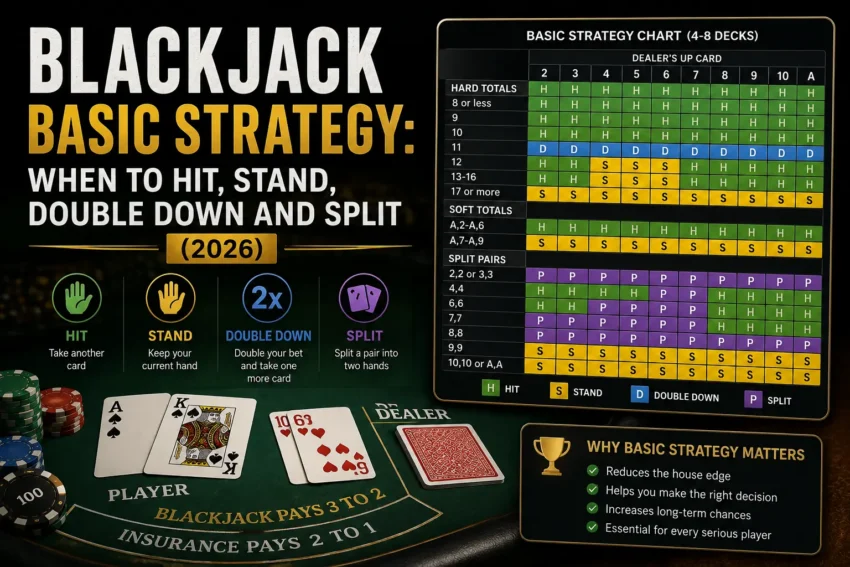
Blackjack is one of the most popular casino card games because the rules are simple to understand, but making the right decision on every hand requires some strategy.
The good news is that you do not have to rely entirely on luck. Blackjack basic strategy (
Play Blackjack Online) uses mathematical probabilities to help you decide whether to hit, stand, double down, or split based on your cards and the dealer’s visible card.
What Is Blackjack Basic Strategy?
Blackjack basic strategy is a set of mathematically calculated decisions that tells you the most statistically favourable action for a particular hand.
Your decision normally depends on two things:
- The total value of your cards
- The dealer’s visible card
For example, the correct decision with a total of 16 can be completely different depending on whether the dealer is showing a 6 or a 10.
Basic strategy does not guarantee that you will win every hand. Instead, its purpose is to help reduce the casino’s mathematical advantage when compared with making decisions randomly.
This is why understanding blackjack strategy is important for players who want to make more informed decisions.
How Does Blackjack Basic Strategy Work?
The basic strategy is based on probability and the expected result of different decisions. In a typical blackjack game, you can choose from several actions:
Hit
Take another card.
Stand
Keep your current hand and take no additional cards.
Double Down
Double your original wager and receive one additional card.
Split
When your first two cards have the same value, you can separate them into two hands and place an additional wager. The best option depends on your hand and the dealer’s upcard.
For example, a player holding 12 against a dealer’s 6 may make a different decision from a player holding 12 against a dealer’s 10.
When Should You Hit in Blackjack?
Hitting means asking for another card. Generally, hitting becomes more attractive when your hand has a low or medium total and the dealer is showing a strong card.
For example, a hard total of 8 is normally too low to stand on, so taking another card is usually the appropriate basic-strategy decision.
Similarly, many hard totals below 12 require another card because standing would leave you with a relatively weak hand.
However, the dealer’s upcard also matters.
Simple rule to remember
Low totals usually require a hit.
As your total becomes higher, the risk of going over 21 increases, so the decision becomes more dependent on the dealer’s card.
When Should You Stand?
Standing means keeping your current cards and allowing the dealer to play their hand. Standing generally becomes more attractive when your hand is already strong or when the dealer is showing a relatively weak upcard.
For example, if you have a strong total and the dealer is showing a low card, taking another card could create unnecessary risk.
A common beginner mistake is hitting too often because they believe another card will automatically improve their hand.
It won’t. Every additional card creates another chance of going over 21.
When Should You Double Down?
Doubling down allows you to increase your original wager, usually by doubling it, in exchange for receiving only one additional card.
This move is attractive when the probability of improving your hand is favourable.
For example, a hard total of 11 is often a strong doubling opportunity in many standard blackjack rule sets because there are many cards that can give you a strong final total.
However, the exact decision depends on the dealer’s upcard and the specific rules of the blackjack game. Before using a doubling strategy, always check the table rules.
Important
Doubling down increases both potential winnings and potential losses. It should not be treated as a way to recover money after losing previous hands.
When Should You Split in Blackjack?
A split is available when your first two cards form a qualifying pair. you then separate the cards into two individual hands and place another wager equal to the original bet.
Some pairs are commonly considered strong splitting opportunities, while others are generally better played as a single hand.
For example, splitting a pair of 8s is a common basic-strategy recommendation under many standard rules because playing 16 as one hand is usually an unfavourable position.
On the other hand, splitting a pair of 10-value cards is generally not recommended because a total of 20 is already a very strong blackjack hand.
A simple way to remember it
Don’t split simply because two cards look identical.
The mathematical value of the resulting hands matters more than the appearance of the cards.
Hard Hands vs Soft Hands in Blackjack
Understanding the difference between hard hands and soft hands makes blackjack strategy easier.
What Is a Hard Hand?
A hard hand is a hand without an Ace being counted as 11 without causing the hand to exceed 21.
For example:
10 + 6 = 16
This is a hard 16.
What Is a Soft Hand?
A soft hand contains an Ace that can be counted as 11 without the hand going over 21.
For example:
Ace + 6 = Soft 17
The Ace can be counted as either 11 or 1. Soft hands provide more flexibility because the Ace can change value if necessary. This is why the correct strategy for a soft hand can be different from a hard hand with the same numerical total.
Why Does the Dealer’s Upcard Matter?
One of the most important concepts in blackjack basic strategy is the dealer’s upcard. The dealer’s visible card gives you information about the probability of the dealer finishing with a strong or weak hand.
Dealer upcards are generally divided into weaker and stronger situations. A dealer showing a low card, such as 4, 5, or 6, can be in a less favourable position because the dealer may be forced to draw additional cards and potentially bust.
A dealer showing a 10 or Ace represents a stronger starting position. This means the same player hand can require a different action depending on the dealer’s visible card.
Blackjack Basic Strategy: Quick Reference
The following general guidelines can help beginners understand the basic concept.
| Your Situation | Typical Strategy |
| Very low hard total | Hit |
| Strong hard total | Stand |
| Hard 11 in many situations | Consider Double Down |
| Strong pair such as 8s | Consider Split |
| Pair of 10-value cards | Usually Stand |
| Soft hands | Strategy depends on dealer upcard |
| Dealer shows a weak card | Standing can become more attractive |
| Dealer shows a strong card | Hitting may be necessary |
These are general principles rather than a complete strategy chart. Exact decisions can change depending on the number of decks, dealer rules, blackjack payout, and other table conditions.
How Blackjack Rules Affect Basic Strategy
Not every blackjack table uses exactly the same rules. Small rule changes can affect the mathematically optimal decision.
Important rules include:
Number of Decks
A game may use one, two, four, six, eight, or another number of decks.
Dealer Hits or Stands on Soft 17
Some tables require the dealer to hit a soft 17, while others require the dealer to stand.
Blackjack Payout
A traditional blackjack may pay 3:2, while some tables use other payout structures.
Doubling Rules
Some games allow doubling on any two cards, while others have restrictions.
Splitting Rules
Rules can differ regarding re-splitting pairs, splitting Aces, and taking additional cards after a split. Because of these differences, a strategy chart designed for one set of rules may not be perfectly accurate for another.
What Is the Blackjack House Edge?
The house edge represents the mathematical advantage the casino has over the player over a large number of bets. Basic strategy can significantly reduce the house edge compared with random decision-making, but it does not eliminate it.
The exact house edge depends on the rules of the game and how accurately the player follows the appropriate strategy. This is one reason why players should compare table rules instead of looking only at minimum bet amounts.
A game with better rules can potentially provide a lower mathematical house edge.
Does Blackjack Basic Strategy Guarantee Winning?
No. This is one of the most important things beginners should understand. Basic strategy is not a guaranteed winning system.
You can follow the mathematically correct decision and still lose the hand.
For example, suppose basic strategy tells you to double down. You could double your bet, receive a poor card, and lose the hand.
The strategy is based on long-term mathematical expectation, not a guarantee about what will happen on the next hand.
Remember:
Good strategy can improve decision-making, but it cannot predict individual blackjack hands.
Common Blackjack Strategy Mistakes
Beginners often make the same mistakes when learning blackjack.
1. Playing Based on Emotions
A player loses several hands and starts making larger bets or changing decisions out of frustration. This does not change the mathematical probability of the next hand.
2. Chasing Losses
Increasing bets simply because you lost previous hands can quickly increase financial risk.
3. Always Standing on 17
Not every 17 is played the same way. A hard 17 and a soft 17 are different hands and can require different decisions.
4. Splitting Every Pair
Two identical cards do not automatically mean that splitting is the best decision.
5. Ignoring Table Rules
Different blackjack rules can change the house edge and the correct basic strategy.
6. Believing in Guaranteed Systems
No blackjack strategy can guarantee consistent winnings. Be cautious of websites or individuals claiming to have a secret method that eliminates casino advantage.
Is Blackjack a Game of Skill or Luck?
Blackjack contains both elements. The cards you receive are determined by the dealing process, so luck plays a significant role in individual hands.
However, players also make decisions that influence the mathematical expectation of those hands. This is where basic strategy becomes useful.
A player who consistently makes mathematically informed decisions can generally perform better over a large sample than someone making decisions randomly.
That does not mean the player is guaranteed to win.
Can You Learn Blackjack Strategy Quickly?
Yes.
The basic concepts can be learned relatively quickly.
Start with these four decisions:
- Hit when your hand needs another card.
- Stand when your total is strong enough for the situation.
- Double down when the mathematical situation supports increasing the wager.
- Split selected pairs when separating them produces a better expected result.
Once you understand these decisions, you can move on to a complete blackjack strategy chart.
The key is consistency.
How to Improve Your Blackjack Knowledge
If you are new to the game, don’t try to memorise everything at once.
A better learning process is:
Step 1: Learn the Rules
Understand card values, blackjack, busting, dealer rules, and available player actions.
Step 2: Learn Hand Types
Understand hard hands, soft hands, and pairs.
Step 3: Learn the Dealer’s Upcard
Understand how the dealer’s visible card affects your decision.
Step 4: Study a Basic Strategy Chart
Use a chart designed specifically for the rules of the game you are playing.
Step 5: Practise Decision-Making
Focus on making the mathematically appropriate decision rather than trying to predict the next card.
Frequently Asked Questions
What is blackjack basic strategy?
Blackjack basic strategy is a mathematically calculated system used to determine whether a player should hit, stand, double down, or split based on their cards and the dealer’s upcard.
Is blackjack basic strategy guaranteed to win?
No. Basic strategy does not guarantee winning. It is designed to make statistically favourable decisions and reduce the house advantage under the applicable game rules.
When should you hit in blackjack?
The correct decision depends on your hand and the dealer’s upcard. Low totals generally require a hit, while stronger totals may call for standing.
When should you stand in blackjack?
Standing is generally appropriate when your hand is strong enough or when the dealer’s upcard makes drawing another card unnecessarily risky.
When should you double down?
Doubling down is generally used when the expected value of increasing your wager and taking one additional card is favourable. The correct decision depends on your hand and the dealer’s upcard.