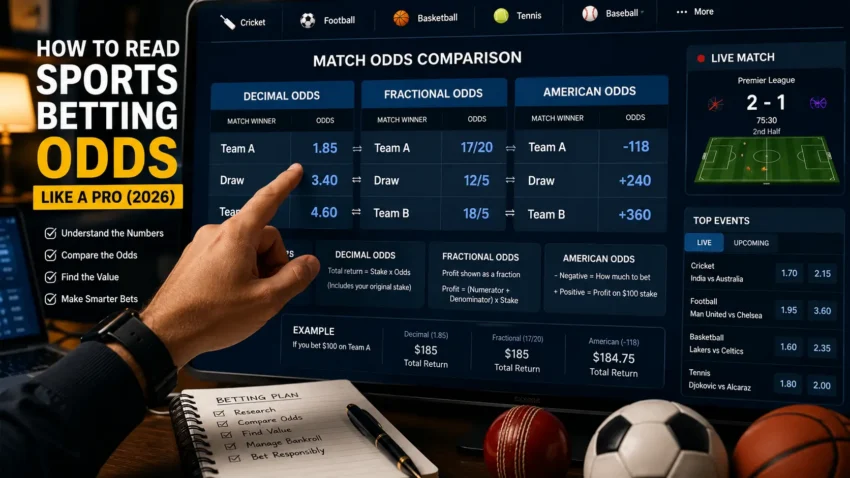
If you’ve ever opened a sports betting platform, you’ve probably noticed numbers like 1.80, 2.50, +150, or 5/2 next to teams or players. These numbers are known as sports betting odds, and understanding them is one of the most important skills for anyone interested in sports betting.
Many beginners think odds are difficult to understand, but they’re actually quite simple once you know what they represent.
What Are Sports Betting Odds?
Sports betting odds represent the probability of an outcome and determine the potential return on a successful bet.
They help sportsbooks estimate how likely an event is to happen while also calculating the payout.
For example:
- Team A – 1.75
- Team B – 2.10
Generally:
- Lower odds suggest the outcome is considered more likely.
- Higher odds suggest the outcome is considered less likely.
Remember, odds reflect probability – not certainty.
Why Understanding Sports Betting Odds Is Important
Learning how to read sports betting odds helps you:
- Understand match probabilities
- Compare betting opportunities
- Calculate potential returns
- Avoid common beginner mistakes
- Make more informed betting decisions
Without understanding odds, it’s difficult to evaluate whether a betting opportunity offers good value.
The Three Main Types of Sports Betting Odds
Most sportsbooks display one of three odds formats.
1. Decimal Odds
Decimal odds are the most common format used across many countries.
Example:
- India to Win – 1.85
- Australia to Win – 2.05
If you place ₹1,000 at odds of 1.85:
Total Return
₹1,850
Profit
₹850
Decimal odds are considered the easiest format for beginners because the calculation is straightforward.
2. Fractional Odds
Fractional odds are commonly associated with horse racing and are still used by some sportsbooks.
Examples include:
- 5/1
- 2/1
- 7/2
If the odds are 5/1, a successful ₹100 bet would return:
- Profit: ₹500
- Total Return: ₹600
Fractional odds show how much profit is earned relative to the stake.
3. American Odds
American odds use positive (+) and negative (-) numbers.
Examples:
+150
-200
Positive odds indicate the potential profit from a standard wager. Negative odds indicate how much must be wagered to earn a target profit.
Many beginners prefer decimal odds because they are easier to understand.
How to Read Sports Betting Odds Step by Step
Follow these simple steps whenever you look at odds.
Step 1: Identify the Odds Format
Check whether the platform uses:
- Decimal
- Fractional
- American
Knowing the format makes interpretation much easier.
Step 2: Compare the Numbers
Example:
Team A – 1.60
Team B – 2.80
The lower number generally represents the favorite.
The higher number represents the underdog.
Step 3: Estimate the Risk
Lower odds usually indicate lower risk but smaller potential returns. Higher odds may offer larger returns but often involve greater uncertainty.
Understanding this balance is key to making informed decisions.
Step 4: Review Match Information
Never rely on odds alone.
Consider factors such as:
- Team form
- Player injuries
- Home or away advantage
- Weather conditions
- Recent head-to-head results
Odds should be one part of your overall analysis.
Why Sports Betting Odds Change
Sports betting odds are constantly updated.
Common reasons include:
Team News
Injuries and lineup changes can significantly affect odds.
Betting Activity
Large amounts of money placed on one outcome often cause sportsbooks to adjust the odds.
Weather Conditions
Rain, wind, or extreme temperatures may influence outdoor sports.
Public Opinion
Popular teams often receive more betting attention, which can impact the odds.
Common Mistakes When Reading Sports Betting Odds
Many beginners misunderstand how odds work.
Avoid these mistakes:
- Assuming lower odds guarantee a win
- Choosing only high odds because of larger payouts
- Ignoring team news
- Not comparing odds across platforms
- Betting emotionally instead of analytically
Understanding odds is about evaluating probability – not predicting certainty.
Tips to Read Sports Betting Odds Like a Pro
Experienced bettors often follow these habits:
- Learn one odds format before exploring others.
- Compare odds across multiple sportsbooks.
- Focus on value rather than popularity.
- Research teams before making decisions.
- Track your betting history.
- Manage your bankroll responsibly.
These practices can help improve long-term decision-making.
Responsible Sports Betting
Sports betting should always be approached responsibly.
Helpful habits include:
- Set a betting budget.
- Take regular breaks.
- Avoid chasing losses.
- Never bet more than you can afford to lose.
- Treat sports betting as entertainment rather than guaranteed income.
Responsible gaming creates a healthier and more sustainable betting experience.
Final Thoughts
Understanding how to read sports betting odds is one of the most valuable skills for beginners. Whether you see decimal, fractional, or American odds, each format provides information about probability and potential returns.
Rather than focusing only on payouts, successful bettors use odds alongside research, statistics, and disciplined bankroll management to make informed decisions. With practice, reading sports betting odds becomes much easier and can help you better understand how sportsbooks evaluate sporting events.
Frequently Asked Questions
What are sports betting odds?
Sports betting odds represent the probability of an event occurring and determine the potential return on a successful bet.
Which sports betting odds format is easiest for beginners?
Decimal odds are generally the easiest because calculating potential returns is straightforward.
Why do sports betting odds change?
Odds change due to factors such as team news, player injuries, betting activity, weather conditions, and market demand.
Do lower odds guarantee a win?
No. Lower odds indicate a higher implied probability, but no outcome in sports is guaranteed.