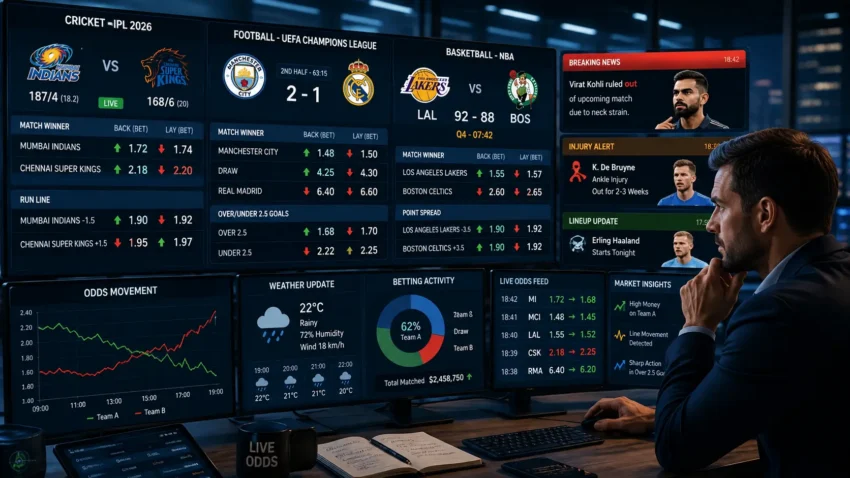
Have you ever checked the odds for a sports match in the morning and noticed that the numbers are different a few hours later? This is completely normal. Sports betting odds can change several times before a match begins, and sometimes the movement can happen within minutes.
There are several reasons behind these changes. Injuries, team lineups, weather conditions, betting activity, and new information can all influence the odds displayed by a sportsbook.
For beginners, these movements can be confusing. Why did the odds change? Does a shorter price mean a team is more likely to win? And should you make a betting decision simply because the odds have moved?
What Does It Mean When Sports Betting Odds Change?
When sports betting odds change, the sportsbook has updated the price attached to a particular outcome.
For example, imagine a cricket match initially has the following odds:
- Team A: 2.00
- Team B: 1.80
Later, Team A’s odds move to 1.75, while Team B’s odds move to 2.10.
This means the market’s assessment of the two outcomes has changed. The movement may be caused by new information, changes in betting activity, or adjustments made by the sportsbook’s pricing models.
However, an important point for beginners is that odds movement does not guarantee a particular result. A team with shorter odds can still lose.
Play Sports Games on – Cricbet99
1. Player Injuries Can Change Betting Odds
Player availability is one of the most important factors affecting sports betting odds.
If a key player is injured or ruled out before a match, sportsbooks may reassess the expected strength of the team. This can lead to a change in the odds.
For example, if a cricket team’s leading bowler is unavailable, the sportsbook may adjust its expectations for the team’s bowling performance. Similarly, a football team may receive different odds if its main striker cannot play.
Sportsbooks may monitor information such as:
- Injuries
- Suspensions
- Illness
- Player withdrawals
- Rested players
This is why checking reliable team news can be useful when trying to understand why odds have moved.
2. Team Lineups Can Change the Market
Official team lineups can have a major impact on betting markets. Once teams announce their starting players, sportsbooks have more information about how strong each side is likely to be.
For example, if a cricket team announces a stronger-than-expected playing XI, its odds may become shorter. Similarly, a football team’s odds could change if several important starters are left out.
Why does this matter? Lineup information often becomes available shortly before a match, which is one reason betting odds can move quickly as the start time approaches.
3. Betting Activity Can Influence Odds
Sportsbooks also monitor how much betting activity is taking place on different outcomes.
Suppose a large amount of money is being placed on one team. The sportsbook may adjust its odds as part of its risk-management process.
This doesn’t necessarily mean that the team has suddenly become more likely to win. The movement can reflect changes in market demand, the sportsbook’s exposure, or new information being incorporated into the market.
This is why you shouldn’t assume that every odds movement is a direct prediction of the final result.
4. New Information Can Move Sports Betting Odds
Sports betting markets can react quickly when important information becomes available.
For example, odds may change after:
- A player is ruled out
- A team announces its lineup
- A coach confirms a tactical change
- New weather information becomes available
- A major team update is released
- Important information about the venue emerges
Sportsbooks continually update their prices as new information becomes available.
5. Weather Conditions Can Affect Odds
Weather can influence many outdoor sports, particularly cricket, football, and tennis.
In cricket, rain, humidity, wind, and pitch conditions can affect how a match is expected to develop. In football, heavy rain or strong wind may influence passing, shooting, and overall playing conditions.
Tennis matches can also be affected by factors such as wind, heat, and rain.
If the weather forecast changes significantly, sportsbooks may adjust their odds to reflect the potential impact on the event.
6. Team Form Can Influence Odds
Recent performance is another factor that sportsbooks consider when creating and adjusting betting markets. A team’s recent results may provide information about its current level of performance. Sportsbooks can consider statistics such as:
- Recent wins and losses
- Goals or runs scored
- Defensive performance
- Home and away results
- Recent player performances
However, recent form is only one factor. A team with several recent wins isn’t automatically guaranteed to win its next match.
7. Statistical Models Can Change Betting Prices
Modern sportsbooks use statistical models to estimate the probability of different outcomes.
These models can process large amounts of information, including team statistics, player performance, historical results, and recent form.
When new data becomes available, the estimated probabilities may change. The sportsbook can then adjust the odds accordingly.
This means that odds aren’t simply chosen randomly. They are generally supported by data, probability estimates, market information, and risk-management processes.
8. Home Advantage Can Affect Sports Betting Odds
The location of a match can also influence betting markets. A team playing at home may benefit from familiar surroundings, local crowd support, reduced travel, and knowledge of the playing conditions.
Sportsbooks can consider these factors when setting their initial prices. If circumstances around the venue change, the market may also respond.
9. Market Sentiment Can Influence Odds
Public interest can have an effect on betting markets as well. Popular teams often attract significant attention from fans and bettors. A highly supported team may receive a large amount of betting interest simply because of its reputation.
However, popularity and probability are not the same thing.
A famous team isn’t guaranteed to win simply because more people are betting on it. This is why it’s important to distinguish between market sentiment and objective sports analysis.
10. Live Betting Causes Rapid Odds Changes
Odds can change even more quickly once a match begins. During live betting, sportsbooks continuously react to what is happening on the field or court.
For example:
- A football goal can immediately change match odds.
- A red card can significantly affect a team’s chances.
- A cricket wicket can change the expected outcome.
- A tennis break of serve can move match prices.
- A serious player injury can cause immediate adjustments.
Live betting markets are therefore much more dynamic than pre-match markets.
Do Shorter Odds Mean a Team Will Win?
No. This is one of the most important things beginners should understand.
If a team’s odds move from 2.00 to 1.60, the market is generally indicating a higher implied probability for that outcome. However, a higher implied probability does not mean the result is guaranteed.
Unexpected results happen in every sport.
Odds represent probability, not certainty.
Why Do Odds Move in Opposite Directions?
When one outcome becomes more strongly favored, the odds for another outcome may move in the opposite direction.
For example:
Team A: 2.20 → 1.80
Team B: 1.70 → 2.00
This can happen when new information changes the market’s assessment of the two teams. The exact movement depends on the sportsbook, market conditions, and the information available at that time.
Should You Bet When Odds Change?
There is no universal rule that says you should bet whenever odds move. Instead, try to understand why the movement happened.
Before making a decision, consider:
- Was there an important injury?
- Have the official lineups been announced?
- Did the weather forecast change?
- Has important team news been released?
- Is the movement connected to market activity?
- Does your own research support the current odds?
Following an odds movement without understanding its cause can lead to poor decisions.
Common Mistakes Beginners Make With Changing Odds
Following Every Odds Movement
Not every odds change represents a useful betting opportunity. Some movements are relatively small and may have little significance.
Assuming Shorter Odds Are Guaranteed
Shorter odds generally indicate a higher implied probability, but they never guarantee the final result.
Ignoring Team News
A sudden odds movement may have a simple explanation, such as an injury or lineup announcement.
Betting Emotionally
Following a popular team because its odds have shortened can lead to decisions based on emotion rather than analysis.
Chasing a Missed Opportunity
If odds move before you place a bet, don’t feel pressured to act immediately. Trying to chase a price can lead to unnecessary risk.
How to Track Sports Betting Odds
If you’re interested in learning how betting markets move, keeping a simple record can be useful.
You could record:
- Opening odds
- Odds before the match
- Major team news
- Lineup announcements
- Weather updates
- Final odds
- Match result
Over time, this can help you understand how different events and information can influence betting markets.
Responsible Sports Betting
Understanding changing odds doesn’t guarantee better betting results. Sports betting involves financial risk, so responsible habits should always come first.
Set a personal budget and avoid using money needed for everyday expenses. Never chase losses by increasing your stakes, and take a break if betting stops feeling like entertainment.
Most importantly, remember that no odds movement can guarantee the outcome of a sporting event.
Frequently Asked Questions
Why do sports betting odds change before a match?
Sports betting odds can change because of injuries, team lineups, weather conditions, betting activity, new information, statistical updates, and changes in market expectations.
Can odds change several times before a match?
Yes. Odds can change multiple times before an event begins, particularly when new information such as team news or official lineups becomes available.
Do shorter odds mean a team is guaranteed to win?
No. Shorter odds generally indicate a higher implied probability, but they do not guarantee the outcome of a sporting event.
Why do live betting odds change so quickly?
Live odds respond to events happening during the match, including goals, wickets, red cards, injuries, score changes, and other developments.
Should beginners follow odds movements?
Beginners can study odds movements to understand how betting markets work, but they shouldn’t assume that every movement represents a betting opportunity.